Read locally. Check the facts.
Draft on a compatible device.
Understand how document reading, bill calculations, reviewed source material and optional local models do different jobs inside GoldRock.
Public implementation guide · Reviewed October 18, 2026 · Native release and device validation remain separate.

Local AI architecture
You do not need a language model to enter a bill, compare supported amounts or use researched workflows. A local model adds wording and explanations after the relevant facts and reference material have been prepared. Keeping those stages separate makes the result easier to review and keeps a model’s guess from becoming a verified payment, deadline or coverage decision.
Separate the parts that matter.
Document reading
The browser renders PDF pages locally and recognizes visible text with locally served OCR components. The native reader uses PDFKit and Apple Vision. Neither stage requires a billing language model.
Deterministic review
Validated fields feed the bill-review engine. It can calculate supported relationships, flag missing inputs and prepare structured questions without inventing a payment or treating an unknown amount as zero.
Reviewed public context
The local knowledge index searches the curated library and its source registry. Coverage, document and goal filters narrow matches. Expired references and manual-only procedures are excluded from model context.
Optional local wording
After a supported model has loaded, the worker can use a question, reviewed facts and bounded public-reference context to draft wording. The person still reviews the answer and decides whether to use it.
Follow the data and the decisions.
- 01
Check the device before choosing a download
The browser checks for a usable GPU adapter and the selected model’s required features. The check is not a measurement of available working memory and cannot guarantee that a large model will load.
The result of this stepA support result and the option to continue without a model.
- 02
Choose a configured public model
The current setup offers Gemma 4 E2B, experimental Qwen3.5 2B and experimental Bonsai 1.7B. Download sizes and working-memory planning estimates are shown separately. Selecting an option does not start its download.
The result of this stepA deliberate model selection, with its size and limitations visible.
- 03
Download and initialize in a dedicated worker
Model files use pinned public revisions. The worker accepts only the configured download addresses while loading. Gemma’s configured file is checked against its expected byte count and SHA-256 digest. Runtime initialization is warmed up with public text.
The result of this stepA loaded-model state only after initialization succeeds.
- 04
Close the worker’s download path for generation
The worker’s download flag is turned off before private input is accepted. Its guarded fetch path rejects network requests during generation. This is a boundary inside the inference worker, not a claim that the entire website, sign-in or billing system is offline.
The result of this stepLocal inference without a remote inference API call from that worker.
- 05
Retrieve relevant reference material locally
A weighted lexical index is built from the public library. Queries are not added to the index. Context contains source applicability and required checks, with a character budget. Source dates remain reference metadata, not invented dates of service.
The result of this stepA bounded reference receipt beside the answer.
- 06
Review the draft or use the original tools
The output is checked for supported structure and some known failure patterns. A rejected, unavailable or stopped model does not silently switch the medical case to a cloud model. Researched steps and manual editing remain available.
The result of this stepWording to review, rather than an automatic filing or negotiation.
Separate the evidence, rules and wording
Evidence on the device
Original document → local reader → explicit fact selection. The document is not a model instruction.
Structured review and public references
Reviewed fields → deterministic comparison. Public library → local retrieval with current citations and applicability checks.
Optional drafting and human review
Question + reviewed facts + public context → loaded local model → checked draft → your edit and sharing decision.
See the state the app actually shows.
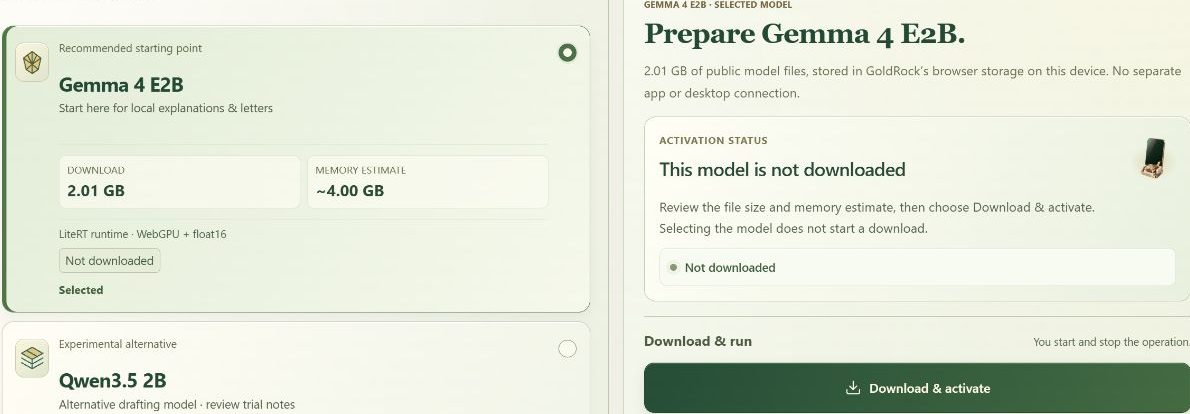
Specifics you can compare.
| Model | Public model download | Working-memory estimate | Execution path |
|---|---|---|---|
| Gemma 4 E2B | 2.01 GB · 2,008,432,640 bytes | About 4.0 GB | LiteRT-LM 0.18.0 · GPU model artifact · WebGPU feature check |
| Qwen3.5 2B · experimental | 1.40 GB · 1,402,859,425 bytes | About 3.5 GB | Transformers.js 4.3.1 · ONNX · WebGPU · q4f16 weights |
| Bonsai 1.7B · experimental | 0.30 GB · 300,184,413 bytes | About 1.5 GB | Transformers.js 4.3.1 · ONNX · WebGPU · q1 weights |
Download figures use decimal GB and cover the configured model artifacts. Runtime files, cache overhead and installation can require additional space. Memory figures are planning estimates, not measurements or promises of device compatibility.
Practical controls and reviewable outputs.
An answer with a reference trail
The explanation can be shown with canonical source links and the scope of the retrieved material. A citation is not evidence that a rule applies to the individual case.
A useful fallback
The bill worksheet, source-linked steps, request templates and editable writing do not disappear when the device cannot load a model.
Separate unload and removal controls
Unloading releases the active model from memory. Removing its public download is a different operation. Neither operation is a substitute for erasing a saved private case or clearing an export.
A clear readiness state
Not downloaded, preparing, loaded, drafting and unavailable are different states. A cached download alone is not proof that inference is ready.
Keep availability and responsibility clear.
Browser implementation
Versioned workers run LiteRT-LM or Transformers.js. ONNX Runtime components are served from the application. Legacy WebLLM metadata is retained separately from the three normal setup choices.
Native iPhone implementation
SwiftUI source includes Apple Foundation Models availability checks and a separate LiteRT-LM Gemma download path. The native Gemma path uses Metal and a pinned public model file. It is a text-drafting path, not a vision model that certifies document redaction.
What remains device-specific
Apple’s model requires iOS 26 and system-reported availability on an eligible device. Native release signing, current Xcode builds, device performance and App Store preparation still require separate Mac and device validation.
Questions worth answering before you rely on it.
Does local inference mean no network activity at all?
No. The site, authentication and benefit administration use network services. Downloading public model files also contacts their host, which can receive ordinary network metadata. The medical-drafting worker is designed to close its network path before private generation.
Can every phone run the models?
No. A browser can expose WebGPU and still fail to allocate the selected model. Available memory, GPU features, browser limits and other apps matter. GoldRock does not promise the same performance on every iPhone or browser.
Are the experimental models reliable medical-billing experts?
No model is treated as a verified authority. The current setup labels Qwen and Bonsai as experimental. Recorded trials include factual and identifier-related failures, and a guard can reject some outputs. These checks do not prove that every incorrect or sensitive output will be caught.
What happens to larger Bonsai options?
The 4B and 8B research entries are disabled in the normal selection UI after ONNX session-allocation failures on the tested Windows device. Their presence in research metadata is not a claim that they run successfully.
Does the model send an appeal or negotiate a bill?
No. It can prepare wording for review. The employee chooses the recipient, checks the facts and decides what to copy, download or send through an appropriate external channel.
Understand the process.
Keep your own decisions.
Use the public sample to explore a fictional case, or sign in to review the tools and settings available to your account and device.